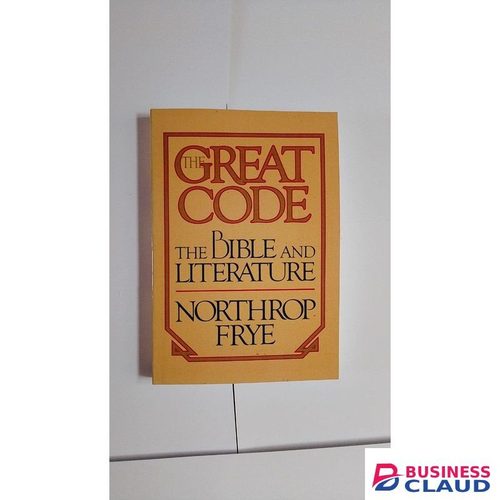
The Great Code: The Bible and Literature
By Northrop Frye
Overview
The Great Code is a seminal work of literary criticism where Northrop Frye explores the Bible's profound impact on Western literature and the broader cultural imagination. Instead of approaching the Bible purely as a theological text, Frye interprets it as a complex literary structure filled with myth, symbolism, and layered language, positioning it as a foundational "code" that shapes Western literary and cultural expression18.
Structure and Central Arguments
Book Division
The book is divided into two main parts:
Part One: "The Order of Words"
Examines the Bible’s unique linguistic and metaphorical framework.
Argues biblical language is deeply figurative and polysemous (multi-layered in meaning).
Establishes principles to interpret the Bible more as a literary text than a theological doctrine83.
Part Two: "The Order of Types"
Focuses on typology: the relationship between Old and New Testament figures and events as reflections of each other in a “double mirror” pattern rather than literal historical correspondence.
Explores the typological interplay where each Testament’s elements act as types and antitypes19.
Key Concepts
| Concept | Description |
|---|
| U-Shaped Narrative | The Bible follows a narrative arc similar to classical comedy: humanity loses the tree and water of life in Genesis and regains them in Revelation3. |
| Phases of Revelation | Frye identifies seven sequential phases shaping biblical narrative: Creation, Revolution (Exodus), Law, Prophecy, Gospel, Apocalypse129. |
| Imagery and Typology | Biblical imagery is classified as Apocalyptic (representing good) or Demonic (representing evil). Evil imagery uniquely parodies or distorts good9. |
| Mythological Universe | The Bible forms the core mythological framework underlying Western literature and cultural identity. Myth here is essential for cultural cohesion5. |
Style and Approach
Frye’s reading deliberately distances itself from theology; he focuses on the Bible as a work of “serious writing” distinguished by its deep, multiple layers of meaning and enduring literary significance. This method emphasizes literary criticism over doctrinal interpretation, highlighting the Bible's role as a model for storytelling and structural design in Western literature38.
Impact and Reception
Considered Frye’s magnum opus, The Great Code has reshaped the understanding of the Bible’s role in literary and cultural traditions.
Its insights have influenced not only biblical studies but also literary criticism, cultural analysis, and critical thinking68.
The book is valued for offering a fresh lens through which literature, myth, and culture can be analyzed, especially in relation to Western civilization1.
Notable Insights
Frye persuasively distinguishes the Bible as a uniquely complex and foundational literary text, different from all other epic or sacred writings9.
He famously states, “A mythology rooted in a specific society transmits a heritage of shared allusion and verbal experience,” underscoring the Bible’s role in creating cultural history5.
Recommended Audience
Students and scholars of literature, biblical studies, and Western cultural history.
Readers interested in the intersection of myth, narrative, and cultural identity.
Anyone seeking to understand the Bible’s literary structure and its foundational influence on Western literary traditions18.